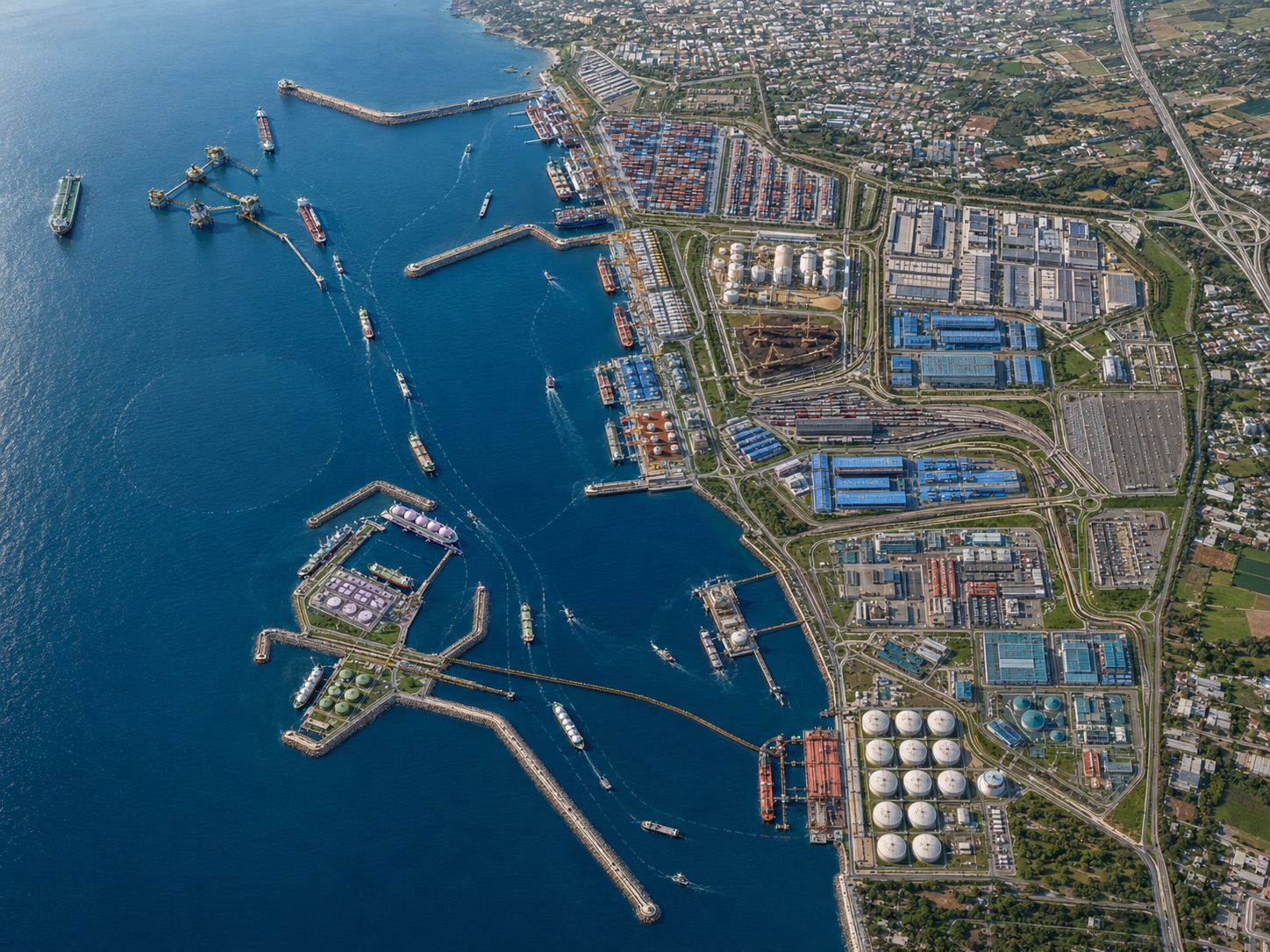
Not a greenfield bet — an existing energy port, modernised.
Baniyas is already Syria's principal energy port. The Gateway complements — rather than competes with — DP World's container concession at Tartous and CMA CGM's at Latakia. Tartous and Latakia take boxes; Baniyas takes energy, gas, bulk, grain and project cargo.
{{ mTitle }}
{{ mBody }}
Mine & Beneficiation "Factory"
Open-pit mining at Khneifiss and Al-Sharqiya with beneficiation at the deposit — 7 Mtpa of 31–34% concentrate loaded to rail from a 3,000-tonne silo, powered by ~60 MWp of captive solar.
The Railway Corridor to Baniyas
A renewal — not a new build — of existing standard-gauge alignment, Khneifiss→Homs→Baniyas. Block trains inbound with phosphate; empty-direction capacity sold as fuel, grain, containers and project cargo.
The Deep-Water Megaport
A protected inner basin plus offshore SPM and island systems — ten terminal families spanning energy, gas, dry bulk, phosphate, grain, general cargo and Ro-Ro, sharing one breakwater, channel and control centre.
Tank Storage & Liquid Bulk
Crude, product and LPG tankage with a metered refinery interface and multi-modal outload — the import infrastructure of reconstruction fuel, staged from a Phase-1 tank farm.
Logistics City & Free Zone
Warehousing, cold chain, bonded logistics, bagging and customs behind the port — converting inbound reconstruction cargo into a counter-cyclical, rail-served second revenue stream.
Six demand pools, one shared cost base.
The Gateway is deliberately not dependent on a single cargo. Phosphate exports, refinery crude and products, gas, dry bulk, grain and reconstruction cargo each ride the same breakwater, channel and control centre — lowering the unit cost of every terminal that shares it.
The first deployment gate is validation, not construction.
Approve a 90–180 day development budget of US$150–250M for surveys, government heads of terms, market sounding, ESIA scoping and pre-FEED — and commit full construction capital only once the critical-path marine, safety, commercial and concession risks are priced, contractual and financeable.
The most important rule is to keep the corridor integrated: mine, railway, port, tank farm, gas, logistics city and cargo contracts negotiated as one investment system — because it is at the interfaces that integrated programmes are won or lost.
Read the comprehensive business plan.
Forty-five pages: strategic context, corridor concept, market analysis, five components, masterplan, capital and revenue models, funding and concession architecture. Edition 3.0.